Read to Your Child Every Day: How (and Why) to Make It Happen
If you ask a teacher how to help your young child succeed, they’ll probably tell you to read more. It seems pretty simple, but starting a daily reading habit with kids does take some intentionality. In this post, I’ll share why it’s absolutely worth the effort PLUS six tips to make it easier.
This post contains affiliate links. See my full disclosure here.

How Does Reading Benefit Children?
When you read to your child every day, you boost their brain development in several ways. Reading supports language acquisition, in part because it exposes children to a richer vocabulary than that of normal conversation. Reading also improves concentration, memory, and self-control. Research across demographics has shown that reading for pleasure in early childhood is associated with better academic performance, fewer mental health problems, and less time spent on electronic devices in adolescence. (source)
When Should You Start Reading to Your Child?
It’s never too early. The American Academy of Pediatrics recommends reading aloud to your child every day from birth. Infants may not sit still for an entire story, but that doesn’t mean they aren’t benefiting! If stopping in the middle of a book bothers you, look for books of poetry or other books where skipping around doesn’t matter.
Is your child is already in school? It’s not too late. The benefits of reading together continue for as long as your child finds it enjoyable! You’d probably have a tough time implementing read-alouds with an older student, but you could still try a family reading time in which each person quietly reads a book of their choice.
How can you create a daily reading routine, starting today?
In the 2018 National Read Aloud Survey, the most common reason parents gave for not reading to their kids was that they “just can’t find the time in the day.” I totally get that. When you have little kids, even simple tasks take a long time. Before you know it, the day is gone. Here are six tips to make reading a natural part of your family’s routine:
1. Start with bedtime
Bedtime stories are part of many families’ routines for a reason. Bedtime is a natural transition and, if it’s going well, it’s a calm and quiet moment in the day. If you don’t read to your child every night before bed, start there. (If you already do this, feel free to skip ahead to Tip #2!)
In our family, there are very few nights when we skip bedtime reading entirely (such as when the bambinos have dozed off in the car on the way home from an outing). We do sometimes extend our bedtime reading, though. If we are fighting an all-out battle over teeth brushing, one book is all we read, but my oldest son loves bedtime stories, so I often offer a second, third, or even fourth book as an incentive to get those pjs on post haste!
Unlike screen-based activities, which stimulate children’s brains with lights and sounds that keep them awake, reading provides a natural bridge to sleep. It also ends the bedtime routine (however chaotic) on a positive note, promoting connection and opportunities to reflect on the day.
If your child isn’t into picture books, consider reading aloud from a chapter book each night instead. Bonus points if it’s a book you remember fondly from your childhood, like Charlotte’s Web, Little House on the Prairie, or Harry Potter.

2. Add a “reading break” at other transition times
Besides bedtime, one of my favorite times to read with my son is right after he gets home from pre-school. He needs a moment to unwind and, given the choice, would probably do so by watching Daniel Tiger’s Neighborhood. I’m not opposed to a little DTN here and there, but I do try to keep screen use to a minimum in our home, so I’ve started avoiding the TV request altogether by saying, “Please put away your shoes and pick out a book!” as soon as we walk in the door. After reading a picture book or two with me, he’s usually ready to play on his own for a bit while I unpack his lunchbox or fold a load of laundry.
Think about the transition times in your daily routine. Are there points when you and your child(ren) need a quiet moment? Times when you are tempted to hand the kids an iPad just to get them out of your face for five seconds? Try adding a brief reading break instead.
(Oh, and by the way, there’s nothing wrong with having your child read independently at these times, even if they’re young enough that “reading” just means looking at the pictures.)
3. Keep books readily available at home
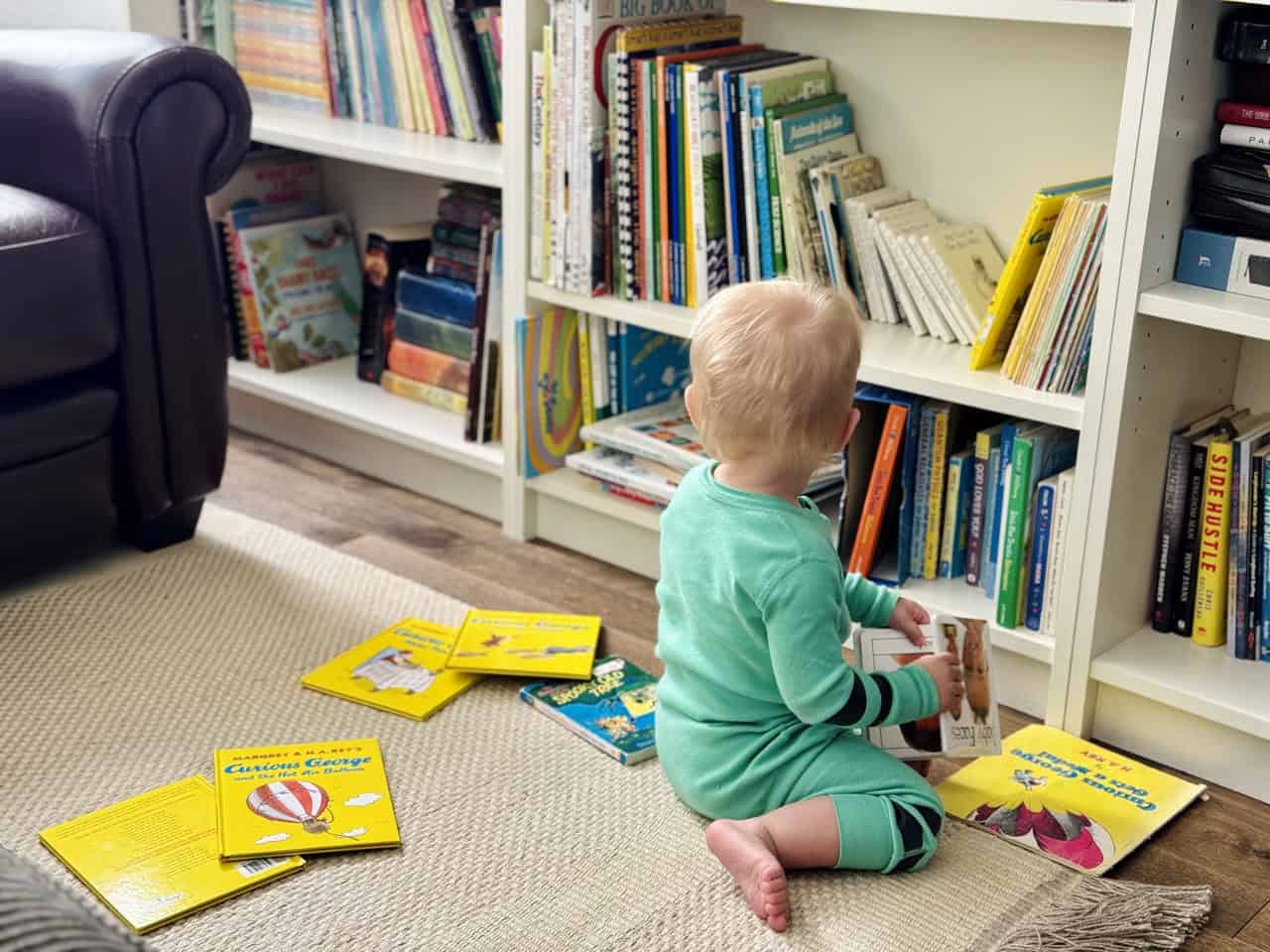
Rather than keeping all of your child’s books in his or her room, consider keeping small collections of books in places you’ll naturally reach for them. I don’t know about you, but if we’ve already snuggled up under a blanket on the couch, the hike upstairs to fetch a book is enough to keep me from initiating storytime.
Besides, if you have a large collection of children’s books like I do, the sheer quantity of options can be overwhelming to young children. They tend to gravitate toward the same stories over and over again anyway, so offering a smaller selection is better. As a bonus, it also limits the size of the mess they can make when they inevitably start throwing books on the floor!
Here are some ideas:
- Keep a small basket or stack of books on your coffee table or wherever you store your TV remotes. This is especially great if you’re working on reducing screen time.
- Do you have a cookbook shelf in your kitchen? Add a few of your kid’s favorites so that you can grab one while you wait for the pasta water to boil.
- Go through your book collection and pull out the “sleepiest” stories (Owl Moon, and Goodnight, Goodnight Construction Site, and Good Night, Little Blue Truck are some of our current favorites). Keep them next to your child’s bed or in another spot that works for your usual bedtime routine. In our house, most of the books are downstairs in our dedicated reading nook, but we have a couch upstairs near our son’s room that’s perfect for pre-bedtime reading, so that’s where the “night night” books live.
4. Take books on the go
I keep a zippered pouch full of books in our car at all times. My sons (ages 3 and 1) aren’t reading independently yet, so I fill this pouch with mostly duplicates of familiar stories OR books that have few words but lots of engaging pictures (Where’s Waldo or C is for Camping, for instance). That way, they can still enjoy flipping through the books on their own even if I’m driving. I also grab the whole pouch and take it with us into restaurants, doctor’s offices, or any other place where we will have to wait.

If you’re going on a road trip or other long drive, consider audiobooks. I’ve used my Audible membership for family-friendly selections in the past, but you can also find Audible’s list of top FREE children’s audiobooks here. You could also check out audiobooks from your local library, either in person or digitally through an app like Libby. Speaking of which…
5. Utilize local library resources
I try to take my kids to the local library at least once per week. We typically check out about five books and sometimes a DVD or two, and we almost always try to time our visit to coincide with storytime. I wasn’t a big library user before I had children, but now that I visit often, I’ve been delighted to find a variety of children’s programs. Of course, your resources may vary depending on where you live, but look into the following:
- Storytime options (For instance, our library has a dedicated baby/toddler storytime that also includes 30 minutes of toy time. My kids love playing with puzzles, cars, and blocks that are different from the ones we have at home, plus they get to practice sharing.)
- Special events for holidays
- Reading clubs, like the annual In-N-Out Cover to Cover club (Kids can earn free burgers by completing a reading challenge.)
- 1000 Books Before Kindergarten programs (I actually haven’t signed up for this because I feel like I read 1000 books per week and I don’t want to have to track every single one of them, but for some families, it could be a good motivator.)
6. Let your child see you reading (not just on your phone)
According to the same 2018 National Read Aloud Survey that I cited earlier, 11% of parents never read for pleasure and another 20% do so less than once a week. There are a thousand things calling for our attention at every turn. I’m someone who loves books, but when I have a spare moment, I still find myself sorting emails, reading news, or paying bills on my phone in an effort to do something “productive” with that extra time. But honestly, even though I perceive what I’m doing to be more important than, say, scrolling on Instagram, it all looks the same to my kids. In some ways, it is. Nothing I’m doing on my phone is as restful or as immersive as reading a book. Spending time on my phone makes me feel more scattered and stressed. Reading doesn’t. It’s that simple.
Young children naturally want to imitate their parents. If they see us reading for pleasure, they will learn to seek out books as well. I love this quote about reading from children’s author Kate DiCamillo: “Reading should not be presented to children as a chore, a duty. It should be offered as a gift.” Reading in front of our children shows them that we value that gift.
JUMP BACK TO…
- Tip #1: Start with bedtime
- Tip #2: Add a “reading break” at other transition times
- Tip #3: Keep books readily available at home
- Tip #4: Take books on the go
- Tip #5: Utilize local library resources
- Tip #6: Let your child see you reading
Is reading to your child part of your day-to-day routine? I’d love to hear about it in the comments below.
PIN IT FOR LATER